I’ll be using Structural Insulated Panels (SIPs) rather than traditional 2x4 framing.
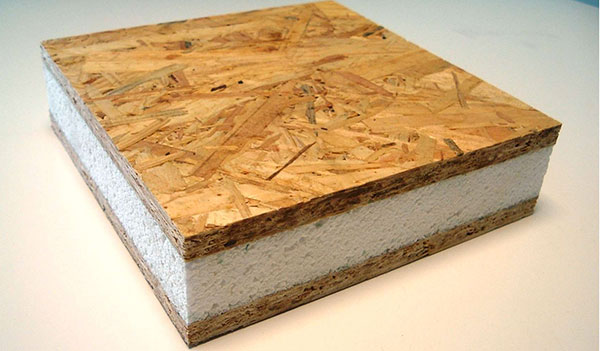
SIPs are made of a foam core sandwiched between two thin skins of oriented strand board (OSB). This design (a torsion box) makes them strong and great insulators.
Here’s an interactive model of how my SIP shell will look:
CONTROLS: mouse drag to orbit. ] and [ keys to zoom in and out.
The benefits of SIPs
-
Construction speed: You can design a building in CAD (e.g. Sketchup), send the designs to a SIP supplier who will cut them perfectly on CNC machines and deliver them to your doorstep. Then you assemble the panels like a giant lego set. I’m expecting my panel assembly to take 1 day (good luck to me…). Alternatively, going the traditional 2x4 framing route entails a lot more labor (framing, sheathing, insulating, vapor sealing, etc.) to get to the same point. Since the whole reason for this project is to practice design and construction, I was initially opposed to SIPs: it seemed like a shortcut. But I eventually decided that, as a first time builder, I’d better take every shortcut that doesn’t decrease quality, and especially those that increase quality. Anyway, there should be plenty of other stuff for me to do after framing.
-
Structural strength: The torsion box characteristic of SIPs makes structures built with them very strong. Since a tiny house on wheels (THOW) will face vibration and high-speed winds hurtling down the highway, this is a must. I initially planned to bolt the roof panels all the way down to the trailer frame with threaded rods through the walls, but the panel supplier I’m using (Panelwrights, which uses Insulspan panels) informed me that was overkill. They’ve done many THOWs using the standard SIP assembly method and never had issues. Since I continued to press for advice on ways to make the structure more wind resistant, he suggested doubling the number of structural screws fastening the roof to the walls and using additional simpson strapping.
Here’s more evidence of SIP strength in the face of hurricane winds.
-
Energy efficiency / greenness: SIP building envelopes are very energy efficient to heat and cool, which is a plus if you believe in anthropogenic climate change. “I don’t!” hisses Charles Koch from the shadows. Well even Charles Koch would agree it’s better not to waste money. SIPs save money over time because they are well insulated and airtight.
-
Insulation: The core of a SIP is insulating foam with a high R-value, and since a SIP building requires less low-R-value studs, the whole-wall insulation of the building is higher than a traditional 2x4 framed building.
-
Airtightness: A properly assembled SIP building envelope is very airtight. That’s good because air leaks constitute a significant portion of an average building’s heat loss. I had a hard time tracking down a specific percentage, but I’ve seen the estimate at up to 35% or 40%. Whatever the exact number is, it makes sense to me: all the insulation in the world won’t help if you leave the windows open.
The SIP industry claims that manufacturing SIPs uses less resources than manufacturing traditional framing materials. This white paper explains why, and it seems reasonable, but I take that with a grain of salt since it’s published by the SIP industry and every citation is by the OSB or EPS industry
¯\_(ツ)_/¯. -
-
Construction cost: The prevailing wisdom seems to be that SIPs cost more up front (material costs) but less in the long run (energy efficiency) than traditional stick framing. However in my case I’ve found the initial cost of SIPs looks about the same as traditional stick framing. I’ll be paying $7.39 per square foot for my SIP shell. I estimate of the cost of a stick frame at $7.12 per square foot. The price difference is just 4%, and my estimate is rough and (I think) probably under, so I’m gonna call it the same – which is a nice surprise.
There are many variables that can affect the up front price, so it’s hard to draw any conclusions based my individual experience. One reason I ended up going with Panelwrights is because another SIP supplier quoted me a much higher price. If I had no choice but that supplier, stick framing would be much cheaper. I also could have reduced my SIP cost significantly if I was willing to wait another month so they could piggyback my order on a larger shipment.
-
Details are exposed early: This is one I didn’t anticipate. Because you need to specify your complete structure, window penetrations, and wire chase locations to the SIP supplier to place your order, you must make a LOT of decisions before anything happens in the physical world. In the traditional stick frame approach, interior stud bays can be left open until relatively late in the construction process. This leaves you flexibility to adjust to unanticipated realities, so some decisions can be left until later.
Take electrical for example: if, after you’ve fully framed and weather sealed your house, you realize you really want the bedroom where the kitchen is, no problem. You update your electrical plan and run wires wherever your heart desires so long as you haven’t closed up the stud bays.
With SIPs, wire chases must be created during the manufacturing process. Manually adding them after the fact, while doable, is an unholy pain. And every additional penetration in the SIP reduces its strength and insulating power. So to order the SIPs you must specify the exact wire chase locations. To specify the wire chase locations you must finalize your electrical plan. To finalize your electrical plan you must know your interior layout (partition walls, cabinetry locations and exact dimensions, etc.) and the exact power draw of your lights, appliances, and outlets. Will you use an electric or propane hot water heater? Propane? Ok, does it still require electric power, and if so, how much? To answer that you need to decided on a specific heater model. What does that model’s installation manual say about how much space is required to either side of the heat exhaust vent. Did someone say propane? Where exactly are you going to run the propane lines? On and on forever until you die.
I’m sure it’s best practice to make all these decisions before you start building regardless of whether you go with SIPs or stick framing. But I know I would have caved to the temptation to start building weeks ago had I not been forced to begin at the root of the decision tree to place my SIP order.
Planning the electrical wire runs
SIP gotchas
There are some things to watch out for with SIPs.
-
OSB and Water: Compared with other materials like plywood, OSB degrades relatively quickly when wet. Keep SIPs dry, and make it possible for them dry out when they inevitably get wet. During construction that means keeping them off the ground and covered. Over the lifetime of the building that means building in an air gap between the SIPs and exterior cladding (a rainscreen) which allows any water to drain out and air to flow through to keep them nice and dry.
-
Ventilation: The extreme airtightness of a SIP structure, which is so good for preventing heat transfer between inside and outside, means unwanted interior pollutants and humidity in the air won’t passively dissipate (assuming the SIP structure will spend some time in climates where you aren’t happy to simply open the windows). Furthermore the EPS foam at the SIPs’ core is “closed-cell” and vapor impermeable, meaning humidity will not diffuse through the walls. Left unmitigated, this would mean mold, water damage from condensation, and probably other bad things.
SIP structures need mechanical ventilation to guarantee good air quality in all climates. Exhaust fans in the bathroom and kitchen remove excess moisture (like shower steam) and pollutants (like cooking smoke). An intake vent must be installed for fresh air to replace the outflow, otherwise the exhaust fans will create a vacuum and your head will explode. Not really, but ventilation won’t go well.
What about when the air outside is humid (Baltimore summer)? An intake vent will bring in that humidity. Yup. I’ll be installing a ductless mini split which, in addition to efficient heating and cooling, has a dehumidification function to keep the interior climate 👌.
The SIP ordering process
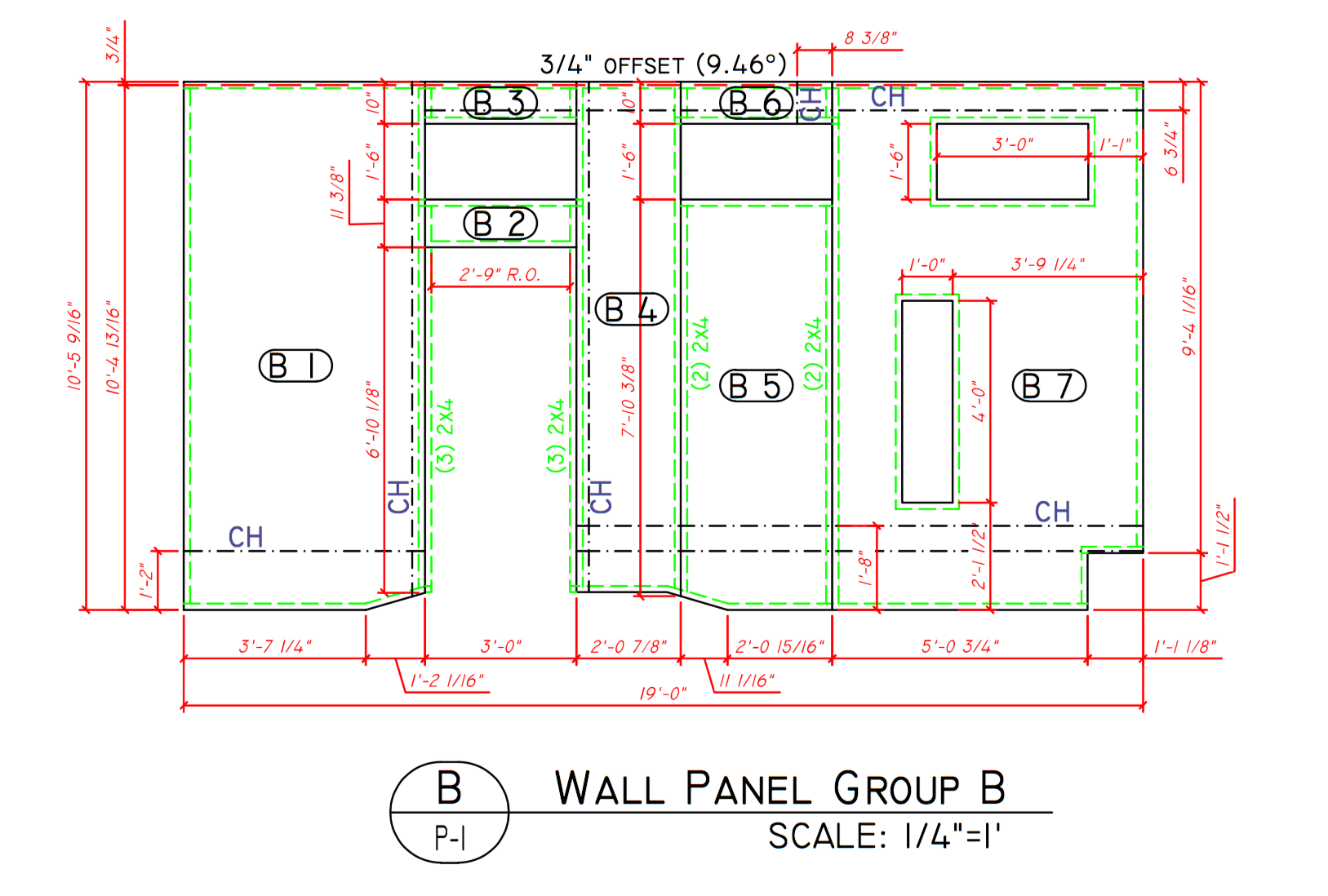 SIP shop drawings specify exactly what panels will make up your structure and how they’ll be assembled
I didn’t find many resources online describing the process of ordering SIPs for a small personal project like this, so here is how my experience went:
- Contact a SIP panel supplier (Panelwrights in my case) for a quote. I sent them:
- Thickness specification: SIPs come in a variety of thicknesses. Because tiny houses have obvious size constraints I requested the thinnest panels (4.5”) to maximize interior space.
- The design: I sent screenshots and a CAD model (.skp file) of my early design draft. Earlier is better as the SIP supplier can recommend changes to make your design more compatible with SIPs. I submitted my model as if every face of my house (walls, roof, floor) would be an unbroken 4.5” thick panel (in reality each face will likely be comprised of multiple contiguous panels). The SIP supplier will figure out the most efficient way to form your building shell.
- Questions: As a total newbie, I had a number of structural design questions that I wanted answered by a professional at the start. For example, my design has an unsupported overhang of about 1’ over the trailer’s tongue. I needed to know if the strength of the walls is sufficient to carry that overhang. They were able to answer this and many other questions and put my mind at ease.
- The SIP supplier gives you a quote specifying what materials and services will be delivered and how much they’ll cost.
- Sign the quote and pay the deposit (15%).
- The supplier will converts your designs into a SIP shop drawing: blueprints of how your panels should be assembled. HERE are mine. It took panelwrights 1 week to produce my shop drawings.
- Review, propose any changes to, and finally approve the shop drawings. I waited until just before approval to submit the location of my wire chases as I was still working on my electrical plan. Upon approval I paid a further 75%.
- The supplier will manufacture and deliver the panels. In my case this will take between 2 and 3 weeks. The final 10% is paid.